

RTÜK Vice President Güler "Ethics in disaster journalism is the foundation of social trust."
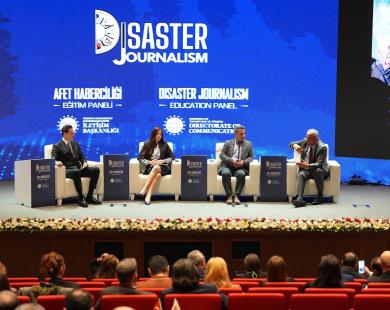
The panel on "Ethical Issues in Disaster Journalism" was moderated by RTÜK Vice President Deniz Güler.
The Radio and Television Supreme Council (RTÜK) Vice President Deniz Güler said “The balance between speed and accuracy in reporting, preventing the re-traumatization of victims, and combating disinformation are among the fundamental ethical issues in disaster journalism.", stating that during disasters, the media is not only responsible for quickly disseminating information but also for protecting human dignity and social sensitivities.
The Disaster Journalism Training Panel, organized under the coordination of the Presidency's Directorate of Communications, was held within the scope of the European Union Erasmus+ Program. The panel was jointly organized by the Directorate of Communications, Selçuk University Faculty of Communication, RTÜK, Konya Metropolitan Municipality Social Innovation Agency, Primorska University (Slovenia), Kyiv University (Ukraine) and Vigo University (Spain). The first session of the panel was moderated by RTÜK Vice President Deniz Güler.
In his speech at the first session of the Disaster Journalism Education Panel titled "Ethical Issues in Disaster Journalism," Mr. Güler pointed out that disaster periods are times when ethical journalism is most intensely tested.
Stating that disaster journalism does not only cover the moment of the disaster, Güler emphasized that the press has essential responsibilities, such as raising public awareness about risks before a disaster, creating consciousness and preventing panic. Güler noted that the tension between speed and accuracy becomes even more pronounced during a disaster, and that unethical reporting can undermine public trust and cause secondary trauma for victims.
Stating that RTÜK guides broadcasters during disasters and operates oversight mechanisms that prioritize the public interest, Güler made the following assessment: “Sharing unverified information during disasters can lead not only to misinformation but also to public panic and loss of trust. Therefore, ethical broadcasting is an essential element in disaster reporting. As RTÜK, we adopt an approach that both provides guidance and upholds the public interest to strengthen ethical broadcasting.”
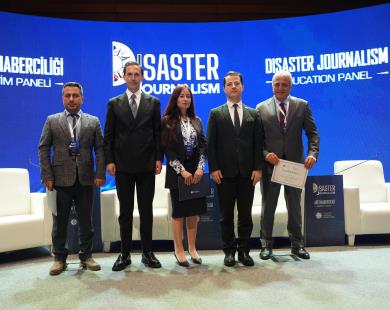
Güler noted that the session featured experienced figures from academia, news agencies and broadcasting. He highlighted the scientific contributions of Assoc. Prof. Dr. Bahar Kayıhan, a faculty member at Ankara Hacı Bayram Veli University; the field experience of Anadolu Agency Gaziantep Regional Manager Kerem Kocalar and the long-standing on-screen experience of TRT News Anchor Fuat Kozluklu brought a multifaceted perspective to the session.
Speaking at the closing of the session, Güler emphasized that accurate communication during disasters is not limited to merely conveying information, stating: "Accurate communication during disasters means preserving the resilience of society, preventing panic, establishing trust and maintaining respect for human dignity under all circumstances. Today's session comprehensively addressed vital topics such as the balance between speed and accuracy, human sensitivity, verification mechanisms, victims' rights and combating disinformation. As RTÜK, we hope that such efforts to strengthen ethical broadcasting practices will continue to increase."