

RTÜK Announced the Results of the “Survey on Youth Media Use and Digital Literacy—2025”
The “Survey on Youth Media Use and Digital Literacy—2025,” conducted by the Radio and Television Supreme Council (RTÜK), revealed striking findings ranging from youngsters’ screen preferences to their news-consumption habits, and from their use of artificial intelligence to their levels of digital awareness.
The relevant study examines the usage habits of youngsters (among 15-21 ages) concerning television, on-demand platforms, radio, internet, and social media, as well as the level of digital literacy
The survey, which was conducted in accordance with age and gender quotas based on current population data from the Turkish Statistical Institute (TÜİK), was carried out with a total of 7,511 youngsters living in 26 provinces at the NUTS-2 level using the computer-assisted telephone interviewing (CATI) method.
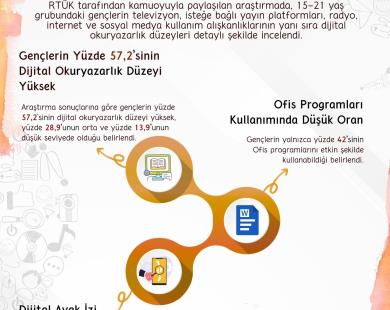
57.2% of Youngsters Have a High Level of Digital Literacy
According to the research findings, 57.2% of youngsters have a high level of digital literacy while 28.9% of them have moderate level, and 13.9% of them have low level of digital literacy.
The study revealed a notable increase in digital literacy levels compared to the data of 2022. According to the findings, while the percetage of people with low digital literacy stood at 35.6% in 2022, this figure dropped to 13.9 % in 2025. Meanwhile, the %age of youngsters with high levels of digital literacy rose from 29.4 % to 57.2 %.
The study found that 62.4 % of youngsters aged 19 to21 had a high level of digital literacy, while this rate was measured as 53.4 % among those aged 15 to 18.
The Usage of Office Software is Found to be Low
The study also revealed some striking findings regarding youngsters’s digital skills. According to that, only 42 % of youngsters can effectively use programs such as Word, Excel, and PowerPoint. This falso highlights the impact of the widespread use of artificial intelligence tools on basic digital skills.
Progress in Digital Footprint Awareness
The study exposed that approximately half of the youngsters have high stage of awareness about their digital footprint. It was reported that 55.3 % of them have a hightened awareness, while 44.7 % have a low stage of awareness on digital footprint. The findings indicated that a significant portion of youngsters need to be trained to be more aware of the digital traces they leave online.
Television Viewing Time Has Declined
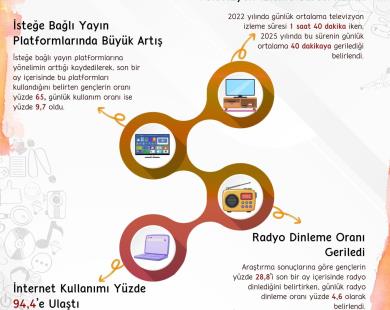
It was observed that, there is a notable decline in youngsters’ television viewing habits. The daily average time was 1 hour and 40 minutes in 2022, whenas in 2025 it was recorded that it dropped to an average of 40 minutes per day.
When 77.4 % of participants reported watching television within the past month, only 10.1 % said they watched television in daily basis. The television viewing rate among women was found to be 80.4 %, on the other hand among men it was 74.5 %.
Significant Increase in On-Demand Platforms
It is noted that there is a growing trend in on-demand platforms. Pursuent to the fact that 65 % of youngsters reported that they have been using these platforms in the last month and the daily usage rate was 9.7 %. Considering that this rate was around 40% in 2022, it has become clear that there has been a significant increase in the use of on-demand platforms among youngsters.
It was found that women’s average daily viewing time is 1 hour, while that of youngsters aged 19 to 21 is 59 minutes.
The Rate of Listening Radio Declined
Although youngsters’ media consumption habits have diversified with the spread of digital media platforms, radio has continued to maintain a special place within this multi-media landscape.
According to the survey results, 28.8 % of youngsters reported listening to the radio in the past month, while the daily radio listening rate was determined to be 4.6 %. Considering that the radio listening rate was 33.8% in 2022, a decline in radio listening among youngsters was observed.
Average daily radio listening time was 33 minutes for women and 44 minutes for men.
Internet Usage Ratio Reaches 94.4 %
The survey revealed that internet usage rates among youngsters are quite high. While 94.4 % of respondents reported that they have been using the internet in the last month in daily bases, where the rate was measured as 78.1 %. The average daily internet usage time among youngsters was calculated to be 4 hours and 37 minutes for female users and 4 hours and 50 minutes for male users. The average daily internet usage time for the 19 to 21 age group was 5 hours and 10 minutes.
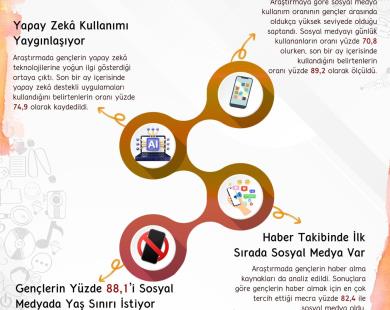
The Use of Artificial Intelligence Is Becoming Widespread
The same study found that youngsters are showing a strong interest in artificial intelligence technologies, whom 74.9 % of them reported that they had used AI-powered applications within the last month.
Nine out of Ten Youngsters Use Social Media
According to the study, the rate of social media use among youngsters was found to be quite high. The ratio of those who use social media in daily basis was 70.8%, while 89.2% reported using within the last month.
The average daily social media usage time among youngsters was calculated as 3 hours and 24 minutes. While the average daily social media usage time for women was 3 hours and 34 minutes, it was 3 hours and 15 minutes for men.
In the study, “following current events” ranked first among the offers of social media use at 86.6 %. It was found that 52.1 % of youngsters use social media to follow brands, while 46.7 % use it for online shopping.
88.1 % of the Youngsters Demand Age Restrictions on Social Media
As a part of the study, youngsters’ views on the appropriate age for starting social media use. According to the findings, 88.1 % of youngsters adviced that there should be 16-year age limit to use social media.
Social Media Tops the List for News Consumption
The study also analyzed youngsters’ source for news. Hereof, social media is the most preferred source for the youngsters to get the news, as it rates 82.4 %. Online news sites follows social media with 75.6 % and television with 53.7 %.
Meanwhile, 47 % of youngsters believe that influencers are effective in helping them access accurate news and information.
The overall assessment section of the study highlights that youngsters’ media usage habits are transforming in line with digitalization; a particularly noticeable increase has been observed in the use of on-demand platforms and artificial intelligence applications.