

Empathy-Oriented Approach Against Cyberbullying Workshop is Completed
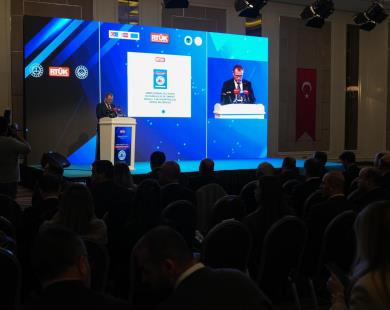
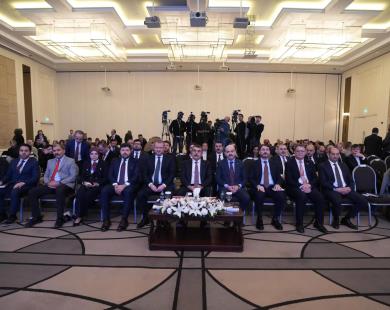
The closing program of the “Resilience and Empathy-Oriented Approach Against Cyberbullying Workshop” was hosted by Radio and Television Supreme Council (RTÜK) in Ankara. The workshop was conducted in cooperation with the Ministry of Family and Social Services, the Ministry of Education, Batman University, and Selçuk University.
‘Closing Program with High-Level of Participation’
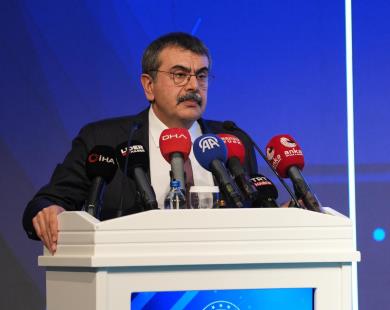
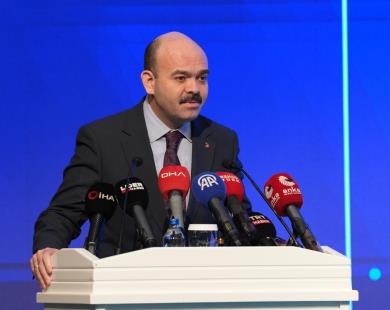
Subsequent to the opening speech delivered by President of the Radio and Television Supreme Council (RTÜK) Mehmet Daniş, Minister of Education Prof. Dr. Yusuf Tekin and Deputy Minister of Family and Social Services Adil Çalışkan addressed the participants.
RTÜK President Daniş shared the efforts on combatting cyberbullying and stated that raising awareness and empowering young people against cyberbullying, one of the major problems of the digital age, is among their primary goals.
Mr. Daniş emphasized that internet technologies transformed communication methods fundementally, while digital world is offering opportunities for fast access to information and global communication, and that online education applications, which became widespread during the pandemic, have provided young people with new opportunities. Mr. Daniş also pointed out that cyberbullying has become a more invisible and widespread problem during this period, and he said; “We must address this issue not merely as an individual behavioral problem, but as a multidimensional psycho-social issue.”
‘Three-Phase Project, Strong Collaboration’
President Daniş shared that the project, supported for 12 months by the Turkish National Agency under the Erasmus+ KA154 Youth Participation Program, and it was implemented in three phases in coordination with RTÜK and in partnership with Batman University and Selçuk University.
Mr. Daniş stated that the project was carried out in three cities: Batman in May 2025, Konya in October 2025, and Ankara in February 2026. He added that 90 young people under the age of 30 and 20 adults over the age of 30 participated in the program. He emphasized that the topic of cyberbullying and empathy was addressed in a multidimensional way through workshops, seminars, drama applications, and group work, and that participants took an active role in the practical work.
Mr. Daniş said, "In the light of this awareness, our Supreme Council, in cooperation with Batman University and Selçuk University within the scope of the European Union Erasmus+ Program, has implemented the ‘Resilience and Empathy-Oriented Approach Against Cyberbullying Program’. With this project, we aim to help our young people gain digital citizenship awareness, develop empathy-based communication skills, cope healthily with the challenges in digital environments, and grow up as individuals who are aware of their rights and responsibilities."
Stating that they attach great importance to producing permanent and sustainable results by systematizing all outputs obtained within the scope of the project, Daniş made the following assessments:
"In this context, I would like to particularly highlight the results and recommendations that surfaced at the end of our workshop. Firstly, we consider it extremely important to promote the ‘cyber courtesy’ approach among all levels of society in order to establish a culture of communication based on respect, responsibility, and empathy in digital environments. A healthy digital future can only be built on ethical values and mutual understanding. In this regard, two important guides have been prepared within the scope of the project.”
Two Important Guides Shared with the Public'
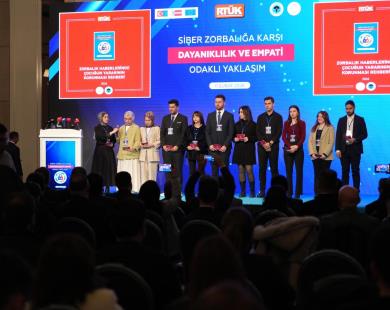
The two important guides prepared during the workshop were announced to the public during the closure. Mr. Daniş shared his ideas about these guides as follows :
"Our first guide is the ‘The Guide to Protecting the Best Interests of the Children in Bullying News”. This guide clearly outlines how the broadcasting approach should be in reporting news which involve children, how privacy and confidentiality principles should be applied, and how the best interests of the children should be protected. It is of great importance for the protection of our children that all our broadcasters integrate this guide, which is prepared for media organizations, to their broadcasting policies. As RTÜK, we will closely monitor this process to strengthen responsible and ethical broadcasting.
Our second guide is the ‘Parents’ Guide to Recognizing Bullying Behaviors’. This guide draws attention to alarming behaviors referred to as ‘Red Flags’ in international literature; it aims to enable parents to recognize risks in advance and intervene consciously. We see it as our fundamental responsibility to support parents, recognizing that the families play an important role in guiding their children’s relation with the digital world. We will share these two guides publicly following our program. By this way, both our media organizations and our families will be provided with the guiding resources. At the same time, through public service announcements and awareness programs, we aim to increase social sensitivity against cyberbullying and create a strong awareness campaign through the media."
'Youth Participation Will Be Increased'
President Daniş stated that they see young people not only as individuals who need protection, but also as stakeholders who play an active role in shaping the digital world. He continued as; “We are working on participatory mechanisms that will reflect the views of our young people in our decision-making processes.” In this context, he reported they still work on establishing “Youth Media Council,” as it is one of the important recommendations of the workshop.
Mr. Daniş underlined that RTÜK defines the digital world as a human-centered, safe, and ethical communication environment, and due to the continued effort, young people will become more conscious, empathetic, confident, and responsible individuals in the digital world. Mr. Daniş presented his thanks to the institutions, academics, stakeholders, and young people who contributed to the project and he wished the workshop will be a success.
Deputy Minister Adil Çalışkan: ‘We Are Building a Safer Digital World for Children’
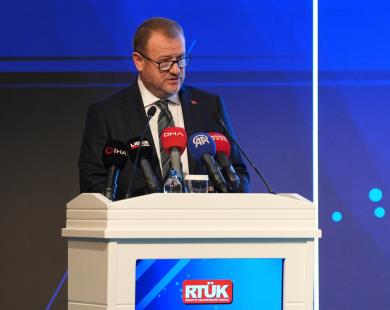
Deputy Minister of Family and Social Services, Adil Çalışkan, after conveying the greetings of Ms. Mahinur Özdemir Göktaş, the Minister, said ;“It is a pleasure for me to participate in this important closing session within the scope of a resilience and empathy-focused approach against cyberbullying.” He emphasized that the digital world creates a new living environment for young people not only physically but also in digital areas. Mr. Çalışkan continued as; “Our young people today are on screens, in games, in applications, and on social media platforms.” He drew attention to the risks coming along with it, such as cyberbullying, digital violence, addiction, and privacy violations. He said, “Therefore, it is of great importance to increase our young people's resilience against the risks in the digital world. In line with the vision set forth by our President, Mr. Recep Tayyip Erdoğan, and with the dedicated efforts of the Ministry of Family and Social Services, we continue working with the motto “Our Family and Our Future” within the scope of the “Family and Population Decade” goals. We aim to protect our youth from digital risks while also enabling them to safely and consciously take advantage of the opportunities offered by the digital world”. Underlining the importance of such workshops, Çalışkan added,” I strongly believe that these projects will make our youth safe and strong in the digital world, and we will build a strong future together."
Minister Yusuf Tekin: “Combating Cyberbullying is a fight for values based on Dignity, Privacy, Respect, and Awareness of Boundaries”
Minister of National Education Yusuf Tekin expressed his wishes for a fruitful, successful, and healthy 2025–2026 academic year, noting that the first week of the spring semester had already passed. Minister Tekin also stated that activities promoting national unity and solidarity would continue in schools in light of the upcoming holy month of Ramadan, which will begin next week.
Minister Tekin stated that Ministry of National Education has implemented important media literacy projects in collaboration with RTÜK in recent years, and said “I would like to highlight that the Ministry of National Education has launched significant media literacy projects in collaboration with RTÜK. These efforts progressed in two dimensions: incorporating content that raises awareness of media literacy into the curriculum and training communication teachers who would pursue graduate education abroad. I would also like to acknowledge the contributions of Prof. Dr. Nabi Avcı, the Minister of National Education at that time, in implementing these projects. Last year, nine different types of literacy were integrated into the curriculum of our new educational programs, which is known as the 'Turkish Century Education Model.' One of those is being carried out in collaboration with RTÜK (Radio and Television Supreme Council)." Minister Tekin indicated that RTÜK's contribution and precision to media literacy is of particular importance, and thanked RTÜK President and his co-workers.
Minister Tekin pointed out that they aim to strengthen a culture that prioritizes respect and courtesy among students, reminding that the use of the term “peer courtesy” should be encouraged instead of “peer bullying.” Minister Tekin stated that cyberbullying, digital security, and protective mechanisms were addressed in this program organized by RTÜK, and he said; “However, the issue is not merely a technical security matter.” “What makes a person human is the measure that protects dignity, the decency that enables privacy, the foundation of respect and justice, along with a sense of boundaries and self-control. In the digital world, the culture of anonymity and speed weakens our moral compass and diminishes the human impact of face-to-face communication. Therefore, cyberbullying is not just a technical platform issue, but also a matter of values. Screens are removing relationships from face-to-face interaction and transforming them into remote contact. This creates an environment where privacy and dignity are more easily violated"
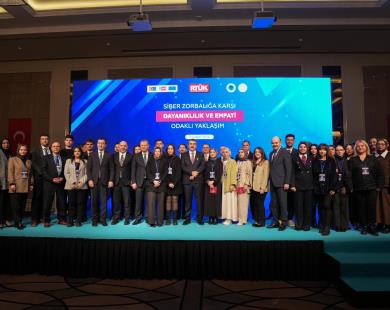
At the end of the program, the outputs of the project and the workshop results were shared with the public. The program highlighted assessments on the importance of institutional cooperation in combating cyberbullying, strengthening empathy-based approaches, and increasing the participation of young people in decision-making processes.
RTÜK members Fatma Çeliker, Orhan Özdemir, and İlhan Taşcı; RTÜK Vice President Dr. Feyzullah Tecirli, Selçuk University Faculty of Communication Department of Public Relations and Advertising Faculty Member, Interpersonal Communication Department Chair Prof. Dr. Mehmet Fidan; Batman University Department of Psychology Faculty Member Dr. Abdullah Manap; and representatives of public institutions and academics also participated the program.